What’s the best water purifier for an apartment?
Apartment living means limited space. You want pure water but worry a good system will take up your valuable space or be too complex to install. From the day I assembled my first purifier, I’ve been thinking about how to solve this problem.
I would say the best choice depends on your lifestyle. If you are a renter, a no-installation countertop purifier is your ideal choice. If you are a homeowner looking to save space, then I would recommend a compact tankless under-sink system.

That’s a great question. Once, a client of mine from Vietnam asked me something similar. My answer was that the choice of a water purifier isn’t really decided by the total area of the apartment, but by more critical factors like “family size,” “available kitchen space,” and “whether you are a renter.” This is because the user’s scenario and needs determine which purifier I can recommend to you. I never chase high profits by pushing recommendations without understanding your real situation and needs. If that affected your sales, it would be a result I would never want to see. I have always believed in a win-win partnership. When your consumers have a great experience with our products, you will naturally sell well, and I will be genuinely happy for you. Now, let’s explore the options from this perspective.
For Renters: What’s the best no-installation option?
As a renter, you can’t drill holes or alter plumbing, which can feel frustrating. You feel stuck with bottled water or basic pitchers, which are either costly or ineffective. I know this dilemma well, which is why we developed powerful, damage-free countertop solutions.
I will tell you, the best no-installation option is a countertop water purifier. I call these “plug-and-play” units; they connect directly to your faucet or have their own internal reservoir. They deliver advanced filtration, including Reverse Osmosis (RO), without any permanent modifications.
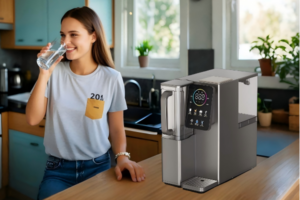
When I first started in this industry, the biggest complaint I received was from apartment dwellers who felt they had too few options. They wanted the power of an under-sink system in a temporary, portable format. This inspired a lot of my innovative thinking in countertop design. It’s not just about convenience; it’s about delivering the same high-quality water. I believe a technical buyer like Phil would appreciate that these units aren’t toys; they are, in my eyes, small water treatment plants for your countertop.
I’ll Help You Compare Your Countertop Options
The key is to understand that “countertop” can mean very different levels of performance. As the source of the product, I must help you see what’s inside.
| Feature | Countertop RO Purifier | Water Filter Pitcher |
|---|---|---|
| Filtration Power | I can ensure it removes >99% of contaminants (lead, TDS, chemicals). | It only reduces chlorine and some sediment; it cannot remove TDS. |
| Installation | I call it “plug-and-play”; just connect it to power. Some models attach to the faucet. | No installation, just add water. Very basic. |
| Water Quality | I guarantee high-purity, consistent water quality. | Varies greatly. In my view, it’s just a basic taste improvement. |
| Long-Term Cost | The initial investment is higher, but the cost per gallon is lower in the long run. | Low initial investment, but a high recurring cost for filter replacement. |
| My Take | For those who are serious about water quality, I see it as an investment in health. | I believe this is just a basic solution for improving the taste of good tap water. |
For the growing rental market, I believe a countertop RO system is an excellent solution. I always emphasize the user experience to my B2B clients. Features like one-touch filter changes and smart TDS monitoring are what make our products stand out. It provides what I stand for: a real solution for a demographic that the market has previously overlooked.
For Homeowners: How to choose a purifier without losing cabinet space?
You own your apartment, but your kitchen cabinet is already full. I guess you must think that a powerful RO system is too bulky to fit. But I want to tell you, modern tankless purifiers are engineered specifically for your situation.
My advice to you is that the best way to save space is by choosing a compact, tankless under-sink Reverse Osmosis (RO) system. These units are much smaller than traditional systems with large storage tanks. My design intention for them was to fit into the tightest spaces while providing pure water.
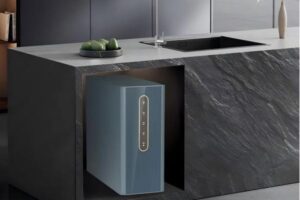
I still remember seeing the first tankless RO prototypes on the factory floor. My first thought was about the engineering challenge: how to provide enough water pressure without a tank. Eventually, we solved this with a more powerful internal booster pump. This design shift was, in my eyes, a game-changer for urban living. It meant homeowners no longer had to sacrifice their entire under-sink cabinet for a glass of pure water.
Tank vs. Tankless: My Space-Saving Breakdown for You
For an engineer like Phil, the decision between a tank and a tankless system comes down to a trade-off between performance specifications and footprint. I see it as a classic engineering trade-off, but modern technology has significantly closed the gap between them.
| Aspect | Tankless RO System | Traditional Tank RO System |
|---|---|---|
| Cabinet Footprint | Very small. Many models I’ve designed are only the size of a shoebox. | Very large. I know it requires significant space for a 2-3 gallon tank. |
| Water Flow | Produces water on demand. I guarantee a continuous, stable flow. | Limited by tank size. The flow slows noticeably as the tank empties. |
| Water Freshness | Water is filtered fresh with every use. I believe this eliminates secondary contamination. | Water is stored, and I must admit this can lead to a stale taste or bacterial growth. |
| Waste Water Ratio | More efficient. Models I’ve worked on can have a ratio as low as 1.5:1. | Older models can be very inefficient. I have seen ratios as high as 4:1. |
| Initial Cost | Higher due to the advanced pump and technology. | Lower initial purchase price. |
From my manufacturing background, building a reliable tankless system is more demanding. It requires a high-quality booster pump and precise flow controls. This is where I advise my clients to look closely at supplier specifications. The longevity and quiet operation of that pump directly determine the end-user’s satisfaction.
Does a compact apartment purifier mean lower performance?
When you see a small, sleek purifier, I guess you assume it must be less powerful. You worry that to save space, the manufacturer must have cut corners on filtration. This is a concern I hear often, and one I completely understand.
My answer is: no, a compact size does not mean lower performance. A well-designed apartment purifier that I’ve worked on, whether countertop or under-sink, can use the same high-quality RO membranes and carbon filters as larger systems. I can guarantee that the filtration quality is exactly the same.
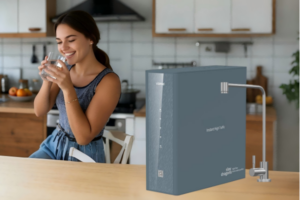
I have personally overseen the production of both large commercial systems and compact residential units. The core technology—the RO membrane—is often the exact same material from the same supplier, just cut and rolled by us into a different size. The fundamental science of purification does not change. In my view, the main engineering difference is the system’s flow rate, which we measure in Gallons Per Day (GPD).
Performance Metrics I Define for Compact Systems
For a buyer like Phil, the data sheet is everything. For me, performance is not an opinion, but a measurable number. When evaluating a compact system, I believe the focus should shift from “is it good enough?” to “does it match the household’s needs?”
| Performance Metric | How I Apply It to Compact Purifiers | What I Recommend You Look For |
|---|---|---|
| Rejection Rate (%) | This measures the RO membrane’s effectiveness at removing Total Dissolved Solids (TDS). I require that a quality compact system must achieve >95% rejection, the same as a large system. | A certified TDS rejection rate. Don’t accept what I call “vague claims.” |
| Flow Rate (GPD) | This measures how much water the system can produce in 24 hours. The compact systems I design typically range from 400 to 800 GPD. | For a family of 1-4, I believe a 400 GPD system is more than enough for daily drinking and cooking. It can fill a glass in about 12 seconds. |
| Filter Stages | A good compact system still offers multiple stages. I guarantee the number of filter stages is not reduced, only the cartridge size. | Look for my clear description of each filter stage and its purpose. |
| Certifications | Third-party certifications (like NSF/ANSI 58) validate my performance claims as a manufacturer. This applies to compact and large systems equally. | Look for NSF or similar certifications for material safety and performance. This is my bottom line. |
I stress this point to my B2B clients: you are not selling a “weaker” product, but a “specialized” product that I have professionally crafted. My engineering focus is on achieving efficiency and space optimization while maintaining the highest purification standards. The value proposition lies in delivering uncompromising water quality in a form factor that fits modern life.
Conclusion
The best apartment purifier is the one that fits your space and your life. Whether you are a renter or a homeowner, I am confident that you can find a compact system that delivers pure, safe water without compromising on performance. Markdown syntax guide