
Your tap water looks clean, but is it truly safe? Invisible contaminants can pose a health risk. Reverse osmosis provides the most complete answer to water purity at home.
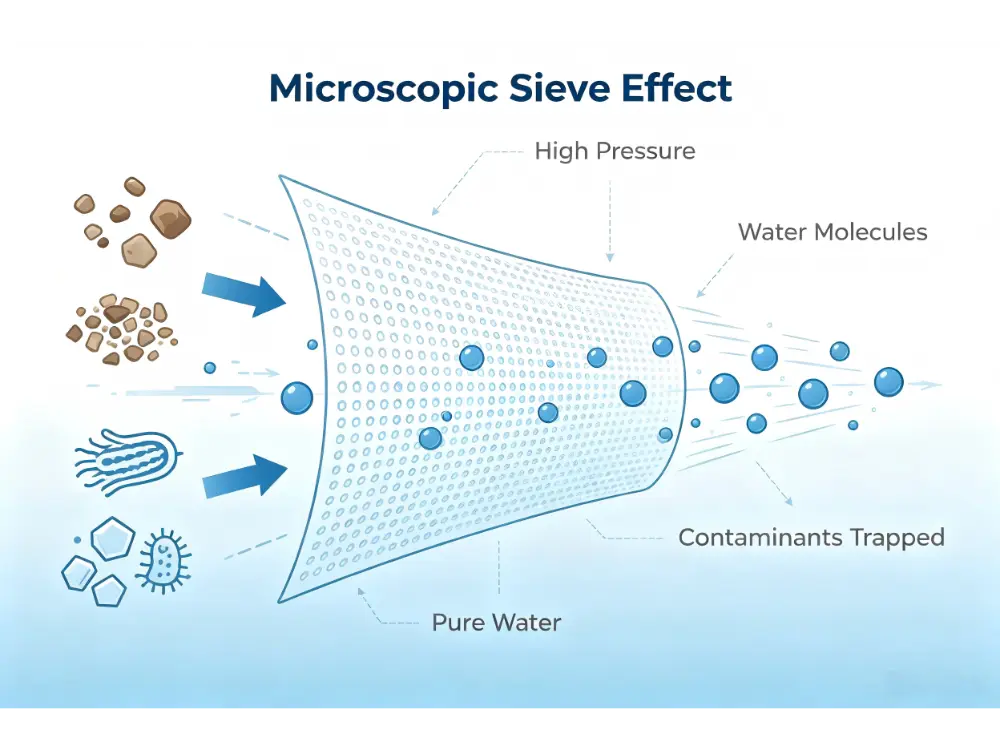
Reverse osmosis (RO) is a process that uses high pressure to push water through a semipermeable membrane. The membrane’s pores are so small that only water molecules can pass through. All larger contaminants like heavy metals, bacteria, and salts are blocked and flushed away.
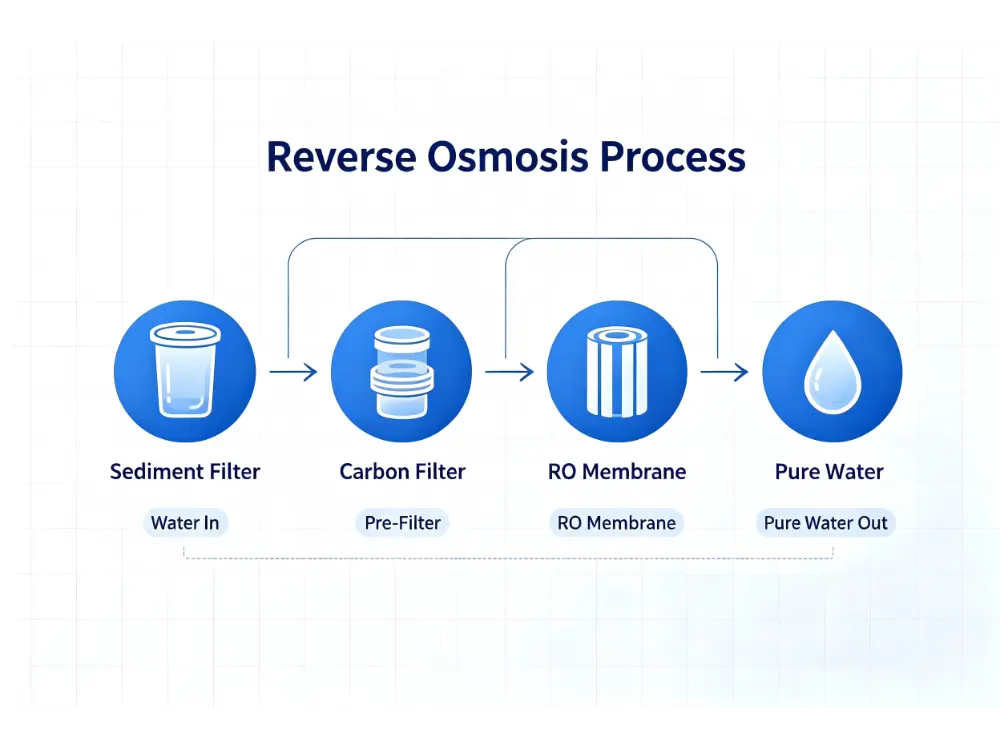
I run my own online stores on our independent website and on Alibaba. I often meet new buyers who want to test a home water purifier before starting a business. They come from Vietnam, the Philippines, Malaysia, Saudi Arabia, and many other countries. Each country has unique water quality, so the right product is always different. Let’s start by explaining the core technology: reverse osmosis.
How Does the RO Membrane Remove Contaminants?
You are told RO purifiers are effective, but how do they work? The science can seem complex. I will explain it in a simple way, based on the products I build myself.
The RO membrane acts as a super-fine sieve. The pores on this sieve are about 0.0001 microns. That is one-millionth the size of a human hair. High pressure forces water molecules through, but almost everything else is left behind.
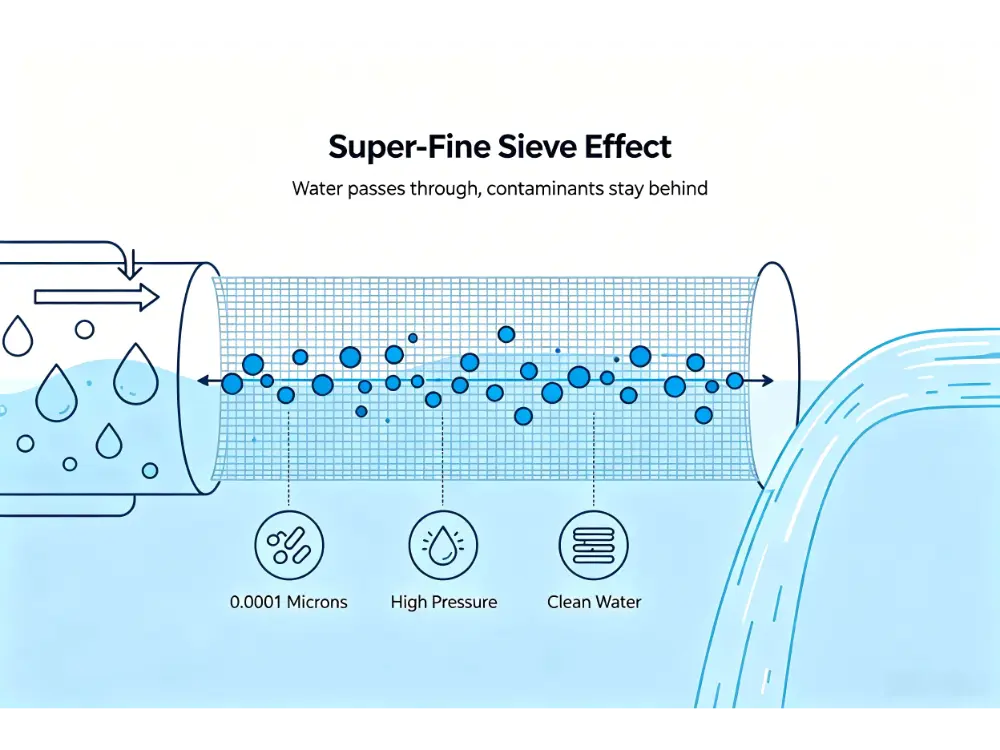
The Power of a Microscopic Sieve
As someone who started on the factory floor, I like to explain things simply. The RO membrane is the heart of the purifier. Its job is to separate good water from bad contaminants. To do this, we use a pump to create high pressure. This pressure pushes the tap water against the membrane. The water molecules are tiny, so they can squeeze through the microscopic pores. But the contaminants—like lead, chlorine, bacteria, viruses, and the minerals that cause scale—are too big. They cannot pass. They are rejected and stay on the other side of the membrane. This is why the water that comes out is essentially pure H₂O. It is a very effective physical barrier. It does not rely on chemicals, just pressure and a very, very fine filter.
What an RO System Removes
An RO system is part of a multi-stage process. Each stage targets different types of impurities.
| Contaminant Type | Sediment Filter | Carbon Filter | RO Membrane |
| Sand, Silt, Rust | Yes | No | Yes |
| Chlorine, Odors | No | Yes | Yes |
| Heavy Metals (Lead, Mercury) | No | No | Yes |
| Bacteria & Viruses | No | No | Yes |
| Dissolved Solids (TDS) | No | No | Yes |
Where Do the Filtered Contaminants Go?
An RO filter blocks impurities, but what happens to them? They do not just disappear. Understanding this is key to how the system stays clean and effective over time.
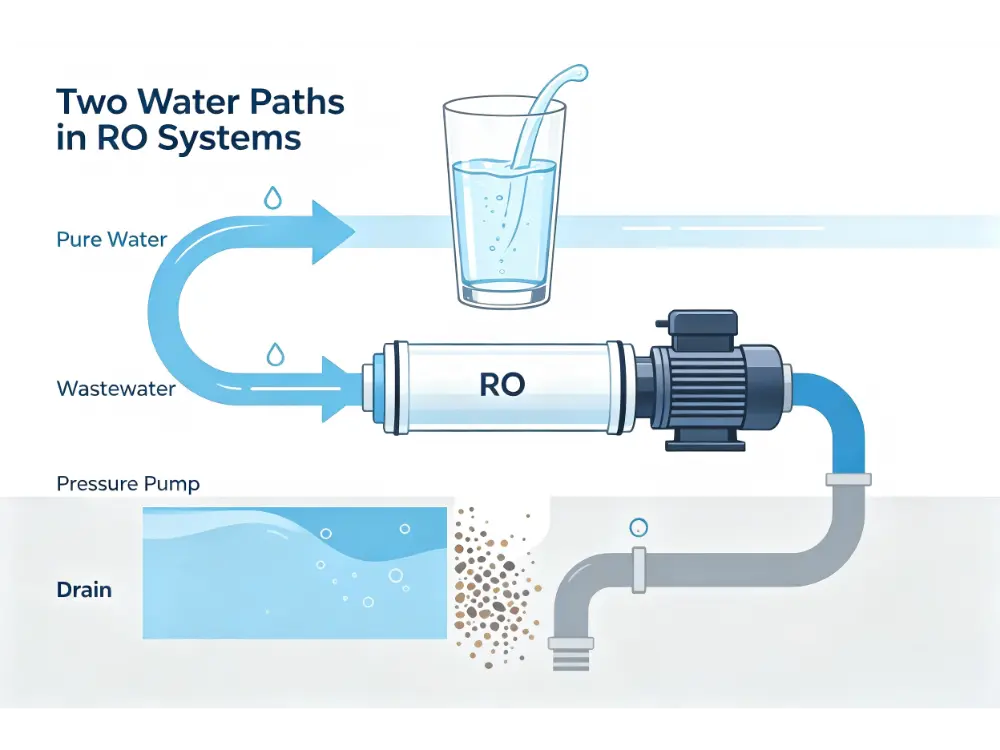
The blocked contaminants are continuously washed away by a stream of water and sent to the drain. This is called the “wastewater” or “brine.” This self-cleaning process prevents the membrane from quickly clogging up and failing.
The Importance of Wastewater
When I talk to new buyers, especially from regions in Southeast Asia or the Middle East where water conservation is important, they always ask about the wastewater. It seems wasteful. But from an engineering perspective, this water is essential for the system to work for a long time. The process is called cross-flow filtration. Instead of water hitting the filter and stopping, it flows across the surface of the membrane. One stream of pure water goes through the membrane. Another stream flows sideways, picking up the rejected contaminants and flushing them out. Without this constant cleaning flow, the membrane surface would become blocked with a layer of slime and scale in a very short time. This would stop the purification process completely. So, the wastewater is actually what keeps the purifier working efficiently day after day.
Common Wastewater Ratios
The ratio of pure water to wastewater can be adjusted based on the system design and water quality.
| Ratio (Waste:Pure) | Efficiency | Best For |
| 3:1 | Standard Efficiency | Areas with very hard water or high TDS |
| 2:1 | Good Efficiency | Typical municipal tap water conditions |
| 1:1 | High Efficiency | Areas with good water quality and conservation needs |
Can You Change the Water After Purification?
RO water is extremely pure, but some people find the taste flat. Can you add minerals back or improve the taste? Yes, the system is flexible.
You can add post-filters after the RO membrane to customize the final drinking water. A T33 carbon filter can improve the taste. Other specialty filters can add healthy minerals back into the water, making it alkaline or hydrogen-rich.
Customizing the Final Product
This customization is very important for business. The ideal water profile is different in every market. After the RO membrane produces pure H₂O, we can build the water back up to meet local preferences. This is a common part of my discussions with international clients. For example, a client in Malaysia might want to add an alkaline filter to raise the pH, which is a popular feature there. A client in the UAE might be more interested in a simple T33 post-carbon filter just to give the water a crisp, fresh taste. We can also add hydrogen-rich filters, which create water with antioxidant properties. As a manufacturer, our job is to provide these options. It allows our clients to create a product that is perfectly suited for their customers. The RO system is the foundation, and the post-filters are the finish.
Popular Post-Filter Options
Here are some common choices for post-RO treatment.
| Filter Type | Primary Function | Effect on Water |
| T33 Post-Carbon | Improves taste and odor | Creates a crisp, polished taste |
| Alkaline Filter | Adds calcium, magnesium | Raises pH, adds healthy minerals |
| Hydrogen-Rich Filter | Infuses molecular hydrogen | Adds antioxidant properties |
Conclusion
Reverse osmosis is a simple, powerful process. It uses pressure to force water through a fine membrane, leaving pure water. It is a reliable technology you can customize for any market.